How to Brief a Warsaw Florist Without Knowing Flower Names
You do not need to know flower names to brief a Warsaw florist well. What you do need is a clear description of the feeling, purpose, format, budget range, and practical constraints. A florist can translate “soft, modern, not too romantic, suitable for a desk” much more effectively than a nervous list of guessed stems. If you are ordering flower delivery in Warsaw, the best briefing is visual, emotional, and logistical rather than botanical.
The trick is to talk like a client, not like a florist. Say what the arrangement should do, where it will go, and what should be avoided. That gives the studio enough information to design something coherent without forcing you to pretend you know the difference between ranunculus and lisianthus.
Describe the outcome, not the stems
Florists work from design cues. If you cannot name flowers, describe the finished result in plain English. Useful cues include mood, scale, color direction, and level of formality.
For example, these are all strong hypothetical briefs:
- “A birthday bouquet that feels cheerful and polished, not childish.”
- “Something calm and elegant in whites and greens for a business thank-you.”
- “A compact flowerbox in warm colors that can sit on a restaurant table.”
- “Loose and airy, with movement, not a stiff round bouquet.”
- “Minimal and modern rather than lush and romantic.”
Those phrases are more helpful than uncertain requests such as “maybe peonies, or roses, or those fluffy white ones.” If you know only one or two flowers you like, mention them as references, not requirements. A florist can then suggest similar shapes or textures depending on current availability.
It also helps to say what you do not want. “Please avoid anything too bright,” “no heavy fragrance if possible,” or “not overly red and heart-shaped” can prevent a mismatch.
Use five briefing categories
If you want your order to go smoothly, organize your message around five simple points. This keeps the conversation efficient, especially when arranging delivery in a large city where timing and practicality matter.
1. Occasion
State the reason for the flowers: birthday, anniversary, thank-you, congratulations, condolence, dinner invitation, new home, or corporate gesture. The same color palette can read very differently depending on context.
2. Recipient and setting
You do not need to profile the person in detail. Just give clues that affect design: whether the arrangement is for a home, office, hospital-adjacent setting, restaurant dinner, or hotel delivery; whether it should be easy to carry; and whether it needs to sit in a small Квітковий магазин на Мокотові space.
3. Style and color
Choose two or three words: natural, refined, dramatic, playful, understated, seasonal, modern, garden-style, structured. Then add a color direction: pastel, monochrome, whites and greens, warm peach and cream, strong jewel tones, or mixed but not too bright.
4. Format
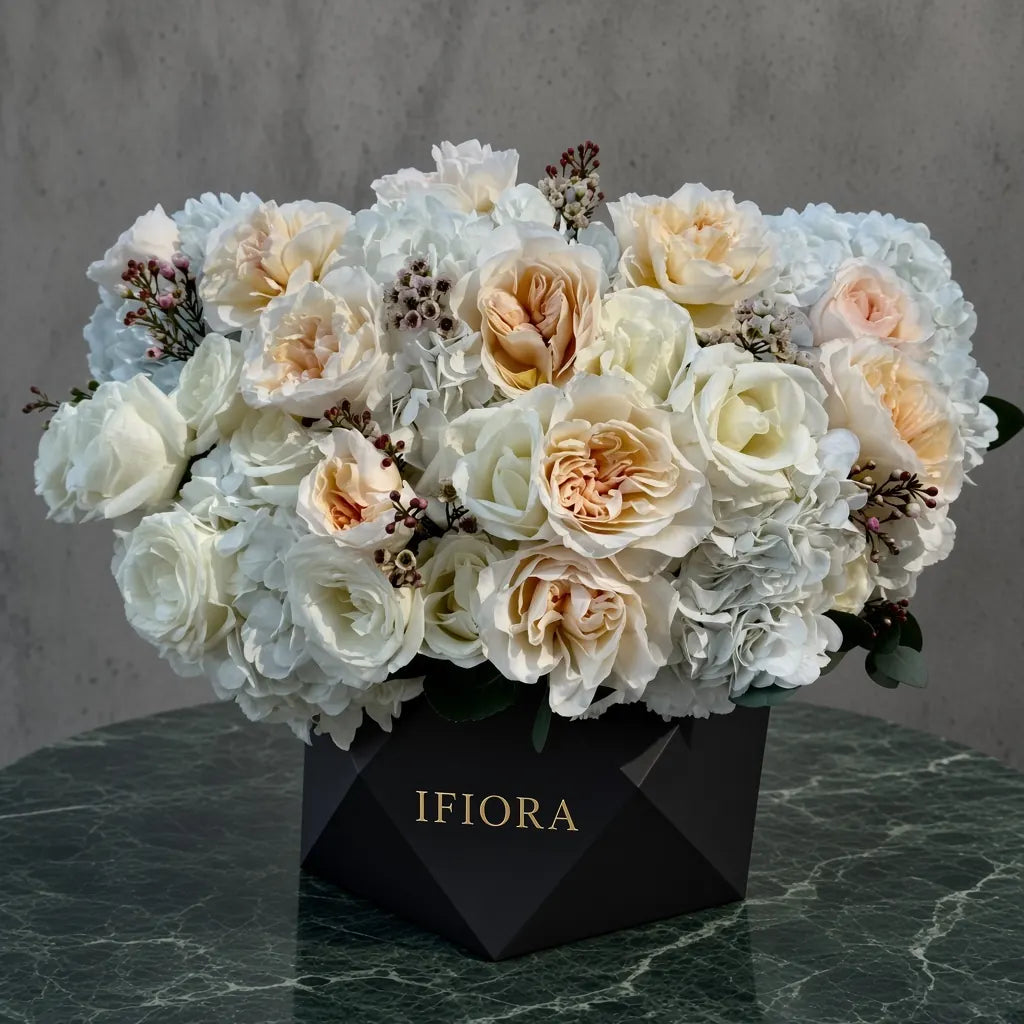
If you do not know flower names, format becomes even more important. You can ask for a bouquet or a flowerbox depending on how the gift will be used. A bouquet may suit someone who can place flowers in a vase at home; a flowerbox may be practical where a ready-to-display arrangement is preferable. If you are ordering from a studio such as IFIORA in Mokotów, bouquet composition, availability, collection time, and delivery slots need to be agreed directly with the florist.
5. Logistics
Include the delivery address in Warsaw, preferred date, time window if relevant, your card message, and any access instructions the florist may need. Keep these details clear and separate from style notes.
Send references that are actually useful
Many people think they need botanical vocabulary when a picture would do the job better. If the florist accepts image references, send one or two examples that show the mood you want. Do not send ten contradictory screenshots. A tight reference set is more usable than a chaotic gallery.
When choosing references, focus on:
- Shape: round, elongated, wild, compact, asymmetrical
- Density: full and lush, or light and airy
- Palette: muted neutrals, fresh greens, bold contrast, soft pinks
- Packaging: clean paper wrap, ribbon, box presentation
You can also describe textures instead of species. Words like soft, sculptural, delicate, textural, or clean-lined are useful. A florist will understand that “something with a few interesting shapes and not too many tiny filler flowers” is a design instruction.
If you have one specific concern, say it directly. For instance: “This is for a professional setting, so I want it warm but not intimate,” or “This is for a small flat, so please keep the scale moderate.” That is more actionable than trying to identify stems from memory.
Know what to decide before you contact the florist
The fastest orders happen when the client has made a few basic decisions in advance. You do not need complete certainty, but you should know your boundaries.
- Budget range: give a realistic bracket rather than asking for “something nice.” Florists design more accurately when they know the scale.
- Non-negotiables: for example, “must be white and green,” “must fit on a reception desk,” or “must feel suitable for congratulations rather than romance.”
- Flexibility: say where substitutions are acceptable. Seasonal availability changes, so openness helps.
- Delivery or collection: decide whether you need delivery within Warsaw or plan to collect from the studio.
One practical example of a concise hypothetical message might be:
“I need flowers delivered in Warsaw on Friday. This is a thank-you gift for a woman in a professional context. Please make it elegant, modern, and light rather than overly romantic. Whites, greens, and one soft accent color would be ideal. A medium bouquet is fine, unless you think a flowerbox is more practical. Please avoid very strong red tones.”
That brief gives the florist enough room to create, while protecting you from an unsuitable result.
What to ask the florist, even if you know nothing about flowers
You are allowed to ask simple questions. In fact, straightforward questions often produce better answers than technical ones.
- Which format suits this occasion best: bouquet or flowerbox?
- What palette would you recommend for this message?
- Can you make it feel modern and understated rather than traditional?
- What details do you need from me to schedule collection or delivery?
- Are there any seasonal limitations I should know about?
These questions invite guidance without pretending expertise. They also help the florist set expectations honestly. Not every stem is available at all times, and not every style works at every size. Agreeing the composition and timing in advance matters more than trying to control every ingredient.
If you are ordering from IFIORA, the studio is located at al. Polski Walczącej 30, lok. U3/A, 00-712 Warszawa, and offers collection and delivery within Warsaw. The practical details should be settled directly with the florist when placing the order.
A short checklist before you press send
- Occasion: Why are you sending flowers?
- Recipient context: Home, office, dinner, formal event?
- Style words: Choose two or three.
- Color direction: Include both preferences and dislikes.
- Format: Bouquet or flowerbox, if you have a preference.
- Scale: Compact, medium, statement piece?
- Budget range: Give a number or bracket.
- Logistics: Address, date, delivery window or collection timing.
- Card message: Keep it ready.
- Flexibility: Allow room for seasonal substitutions.
The best florist briefs are not botanical exams. They are clear, calm instructions about intent, style, and logistics. In Warsaw, where same-day assumptions and busy schedules can lead to rushed communication, precision matters. Tell the florist how you want the flowers to feel, where they are going, and what must be avoided. That is enough to get a thoughtful result, even if you cannot name a single stem.
IFIORA
al. Polski Walczącej 30, lok. U3/A
00-712 Warszawa, Polska
Tel.: +48 883 338 113
https://www.ifiora.com/